- Endoplasmic reticulum:
- A network of channels seen extending throughout the cytoplasm. it can be seen under an electron microscope with resolution 2 to 4 Angstrom(Å). these channels are continuous with plasma membrane and also appear to be in contact with the nuclear membrane. this entire system of channels is called endoplasmic reticulum. It maintains its shape by providing mechanical support to the cell
- Discovery: The ER was first noted in the late 19th century when studies of stained cells indicated the presence of some type of extensive cytoplasmic structure, then known as the gastroplasm.
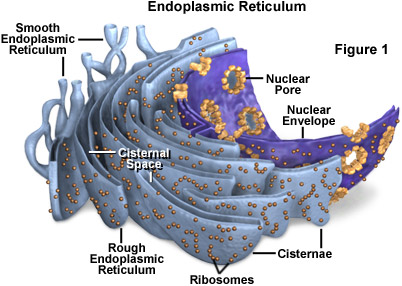
- Appearence: Appearance vary from cell to cell.i.e one cell has a different appearance of endoplasmic reticulum than the other cell
- .Cisternae: These are the most important part of endoplasmic reticulum.these are the channels that are present in endoplasmic reticulum. These are spherical or tubular membranes. The material present in cisternae is separated from endoplasmic reticulum by these membranes
3.Morphological forms: There are two morphological forms:
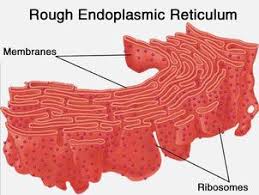
| RER | SER |
| With attached ribosomes | Without ribosomes |
| Rough form | Smooth form |
| Has cisternae | Has tubules |
| More stable(as present nearest the nucleus). | Less stable(as present nearest the cell membrane) |
| Less sensitive | More sensitive(as any damage to plasma membrane first damages the SER |
| Involve in the synthesis of protein | Involve in lipid metabolism |
| Protein glycosilation( conversion of proteins into glyco proteins)occur in lumen of RER | Helps in metabolism of diff. molecules especially lipids |
| Provide mechanical support to the cell | Provide mechanical support to the cell. |
 |  |
- 4. Other Functions of SER: SER helps in metabolism of different types of molecules particularly lipids.
- SER involves in detoxification of harmful drugs e.g toxins, carcinogens, and steroids.
- Responsible for transmission of impulses in muscle cell and nervous cell.
- Help in detoxification of harmful drugs.E.g toxins, carcinogen and steroids.
- Play an important role in transport of materials within the same cells
- 5.Pathway of protein: proteins are synthesized on ribosomes
- RIBOSOMES > CHANNELS OF ER >GOLGI APPARATUS > OUTSIDE THE CELL
- 6. Structure:
- The general stucture of the ER is a network of membranes called CISTERNA .
- These cisternae are held together by cytoskeleton.
- Cisternal space is enclosed by PHOSPHOPLIPID MEMBRANE
- .The cisternal space is also called LUMEN which is continous with space around the nucleus called PERINUCLEAR SPACE but seperate from the cytosol.
- Protein is synthesized on ribosomes. Thus factory of protein synthesis is RIBOSOMES
- ER can account for more than 50% of total lipid bilayer of the cell
- 7. ER membrane system: particularly prominent in pancreatic BETA CELLS that secrete insulin or within activated BETA lymphocytes that produce antibodies.
-
right sidebar


6 Comments
very informative
ReplyDeleteplz share this information with others also
ReplyDeletever nice
ReplyDeletever nice
ReplyDeletever nice
ReplyDeletegood work keep it up☺
ReplyDelete